
Fuming Chamber
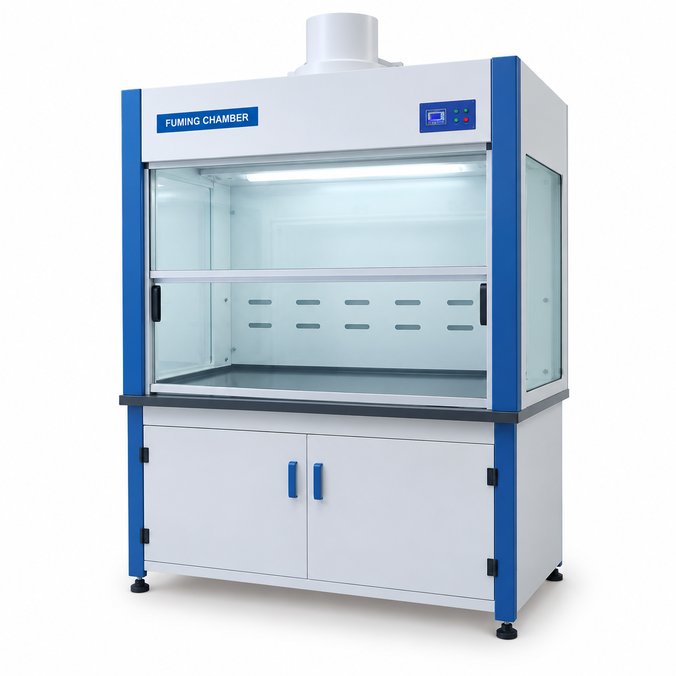
A Fuming Chamber is a sealed laboratory enclosure used to develop latent fingerprints on non-porous items—such as glass, plastic, metal, and painted surfaces—by exposing them to cyanoacrylate (“super glue”) vapor under controlled conditions. It contains the irritating fumes, controls humidity and exposure time, and then purges or filters the vapor for operator safety.
How Fuming Chamber works
-
Evidence is placed on shelves or hanging rods inside the chamber.
-
A small amount of ethyl cyanoacrylate is heated on a hot plate, producing vapor.
-
The chamber circulates the vapor at controlled humidity—typically around 50–80% relative humidity in automated systems—so the vapor polymerizes on fingerprint residue, forming a visible white deposit.
-
After the cycle, the chamber purges air through activated-carbon filtration or exhausts it safely, preventing operator exposure.
Key features
-
Controlled environment: Automated time, temperature, humidity, circulation, and purge settings improve reproducibility.
-
Safety containment: Airtight doors, locking mechanisms, and carbon filtration prevent cyanoacrylate fumes from escaping into the room.
-
Evidence handling: Internal shelves, hanging rods, and clips allow items of different sizes to be positioned properly.
-
Ductless options: Many modern units recirculate air through carbon filters, so they do not require external ducting.
-