
Biosafety Cabinet
Based Upon The Containment Capabilities Filter Efficiency And Working With Biological Agents Biological Safety Cabinets Are Into Three Categories Class I, Class II , Class III. CLASS I BIOLOGICAL SAFETY…
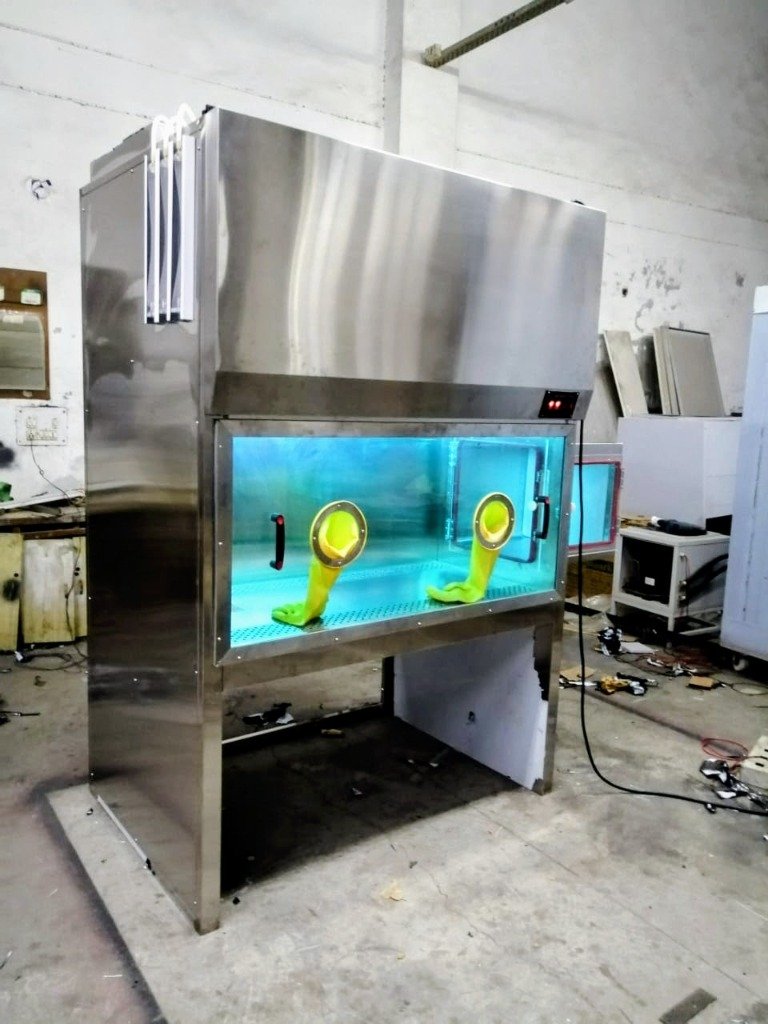
Based Upon The Containment Capabilities Filter Efficiency And Working With Biological Agents Biological Safety Cabinets Are Into Three Categories Class I, Class II , Class III.
CLASS I BIOLOGICAL SAFETY CABINET
Class I Biological Safety Cabinets Are Used In Microbiological, Laboratory, Genetics, Cell Biology, Molecular Biology, Cell Culturing.
CLASS II BIOLOGICAL SAFETY CABINET
Class II Biological Safety Cabinet Is A Ventilated Cabinet And Fan Mounted On The Top Of The Cabinet Which Protects Operator, Protection And Environment From Potentially Dangerous Microbiological Agents. It Operates With Negative Air Pressure For Protection And HEPA Filtered Laminar Airflow. It Has A Plenum From Which 30% Of Air Is Exhausted, And 70% Re-Circulated To Area. Class II Biological Safety Cabinet Are Used In Cell Culturing, Genetics, Research, Cell Biology, Microbiological And Molecular Bio Furthermore, There Are Four Types Of Class II BSC – Type A1, A2, B1, B2 Depending Upon The Ratio Of Air Exhausted From The BSC Air That Is Re-Circulated Within The BSC And The Type Of Exhaust System Used. The Class II Biological Safety Cabinet Is Equipped With A Dual HEPA Filter System. The Amount Of Air That Re-Circulates Or Depends On The Type Of BSC.
TYPES OF CLASS II BIOLOGICAL SAFETY CABINET
Type A1 Biological Safety Cabinet
- HEPA Filtered Down Flow
- Airflow System-70% Of Air Is Re-Circulated Within The Cabinet And 30% If The HEPA Filtered Air Is Exhausted Into The Laboratory.
- Inflow Velocity-0.38m/S
- Contaminant Air Is Under Negative Pressure And Unfiltered Air Is Under Positive Pressure.
- Contamination And Protection – Not Suitable For Use With Chemicals.
Type A2 Biological Safety Cabinet
- HEPA Filtered Down Flow
- Airflow System-70% Of Air Is Re-Circulated Within The Cabinet And 30% Of The HEPA Filtered Air Is Exhausted Into The Laboratory.
- Inflow Velocity-0.52 M/S
- Contaminant Air Is Under Negative Pressure And Unfiltered Air Is Under Positive Pressure.
- Contamination And Protection- Only If Exhausted To Facility Exhaust System
Type B1 Biological Safety Cabinet
- HEPA Filtered Down Flow
- Use Single- Pass Airflow To Control The Flow Of Hazardous Vapours
- Airflow System- 30% Of Air Is Re-Circulated Within The Cabinet And 70% Of The HEPA Filtered Air Is Exhausted To An External System
- Hard Ducted
- The Exhaust Air Dispersed Out Of The Facility Should Be Passed Through The HEPA Filters To Provide Protection To The Environment
- May Have Biologically Contaminated Ducts And Plenums Under Negative Pressure
Type B2 Biological Safety Cabinet
- HEPA Filtered Down Flow
- Airflow System- 100% Of The HEPA Filtered Air Is Exhausted From The Cabinet
- Hard Ducted
- All Ducts And Plenums Are Under Negative Pressure
- All Contaminated Ducts Are Under Negative Pressure Or By Directly Exhausted Negative Pressure Ducts Or Plenums.
CLASS III BIOLOGICAL SAFETY CABINET
Class III Biological Safety Cabinet Are Totally Aerosol-Tight Enclosed With A Non-Opening, Completely Sealed, Front Window. It The Highest Level Of Personnel Protection And Is Used For Risk Group 4 Agents.
Class III Biological Safety Cabinet Are Used In Toxic Chemicals, Laboratory, Potential Carcinogens, Hazardous Contact Research. The Cabinet Is Also Associated With Attached Rubber Gloves Attached To The Ports In The Front Of The Safety Cabinet. The Cabinet Referred To As A “Glove Box”. The Work Is Carried Out Using These Glove Box. This Allows Access And Work To Be Performed Product Within The Cabinet Without Any Contamination Of The Sample. The Exhaust Air Is Treated With Double HEPA Filters Or HEI In Combination With Incineration Class III Biological Safety Cabinet Is Used With High Risk Biological Agents And When Containment Of Highly Infectious Or Hazardous Material Is Required.
FEATURES OF BIOLOGICAL SAFETY CABINET
| BSC Type | Airflow (Re-Circulated) | Airflow (Exhaust) | Exhaust System |
|---|---|---|---|
| Class I | 0 | 100 | Hard Duct |
| Class II Type A1 | 70 | 30 | Exhaust To Room Or Connect To Another System Exhaust |
| Class II Type A2 | 70 | 30 | Exhaust To Room Or Connect To Building Exhaust |
| Class II Type B1 | 30 | 70 | Hard Duct |
| Class II Type B2 | 0 | 100 | Hard Duct |
| Class III | 0 | 100 | Hard Duct |
Applications
- Microbiology Laboratories.
- Cell Culture Laboratories.
- Pharmaceutical Quality Control Laboratories.
- Biotechnology And Molecular Biology Laboratories.
- Clinical Diagnostic Laboratories.
- Hospitals And Healthcare Institutions.
- Vaccine And Biologics Manufacturing.
- Research And Development Laboratories.
- Universities And Academic Institutions.
- Tissue Culture And Microbiological Testing.
Specifications
| # | Parameter | Specification |
|---|---|---|
| 1 | MOC | Powder Coated Mild Steel /Stainless Steel |
| 2 | Working Area WxDxH | 600x600x600mm,900x600x600mm,1200x600x600mm,1800x600x600mm |
| 3 | Pre-filter | Washable Pre-filter Down To 10 Microns, Particulate At An Efficiency Of 90% Duly Tested |
| 4 | HEPA-Filter | With 0.3 Microns Particulate Of 99.99% Efficiency And DOP Tested, Frame Of Aluminium, Microfiber Glass Media Epoxy Sealed, Non Washable |
| 5 | Class | 100 |
| 6 | Motor Blower Assembly | Dynamically Balanced |
| 7 | Noise Level | Minimum |
| 8 | Front Door | Folding Transparent Acrylic (Polycarbonate Optional) |
| 9 | Sides | Transparent |
| 10 | Working Bench | Stainless Steel |
| 11 | Illumination | Fluorescent Light |
| 12 | Germicidal Activity | U V Tube |
| 13 | Air Pressure | Static Manometer / Magnahelic Gauge (Option) |
| 14 | Utility | Power Socket, Vacuum/Gas Cock |
| 15 | Electric Supply | Work On 220v AC 1 Phase |
Get a Custom Quote Today
Talk to our contamination control specialists for sizing, pricing, installation and after-sales service across India.