
Fume Cabinet
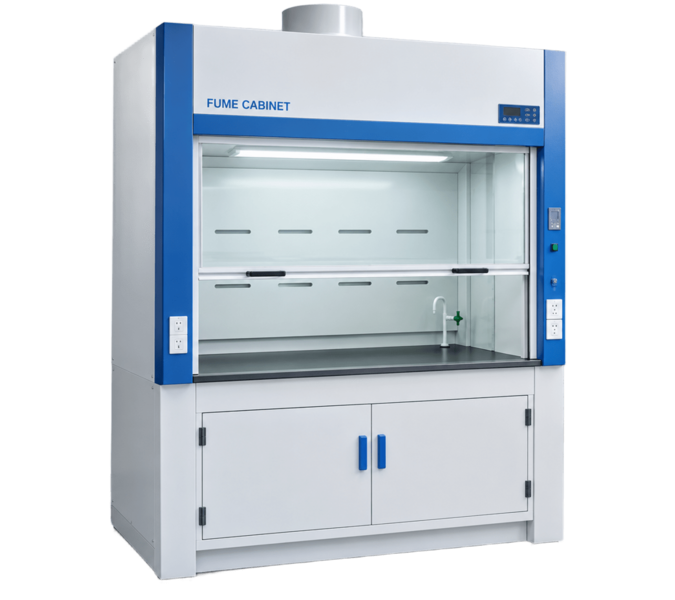
A Fume Cabinet—also called a fume hood or fume cupboard—is a ventilated enclosure that captures hazardous fumes, vapours, gases, and fine particles at the work surface, protecting the operator and laboratory environment.
How Fume Cabinet works
Air is drawn through the front opening and sash, carrying contaminants away from the user. A ducted cabinet exhausts the contaminated air outside, while a ductless/recirculating cabinet filters it—typically through activated-carbon and particulate filters—before returning it to the room.
| Type | Best for | Key consideration |
| Ducted | High-volume or highly hazardous chemical work | Requires ducting, blower, and safe external discharge |
| Ductless | Low-volume solvent, adhesive, soldering, and teaching-lab work | Filter type must match the chemicals; filters need monitoring/ replacement |
| Benchtop | Dental labs, electronics rework, small-scale lab processes | Compact, portable, and often recirculating |
Common applications
Fume cabinets are used where solvents, acids, adhesives, resins, coatings, soldering flux, aerosols, or hazardous powders are handled. Typical settings include chemistry and pharmaceutical laboratories, dental labs, electronics assembly/rework, educational labs, and industrial workstations.