
Self Contained Fume Hood
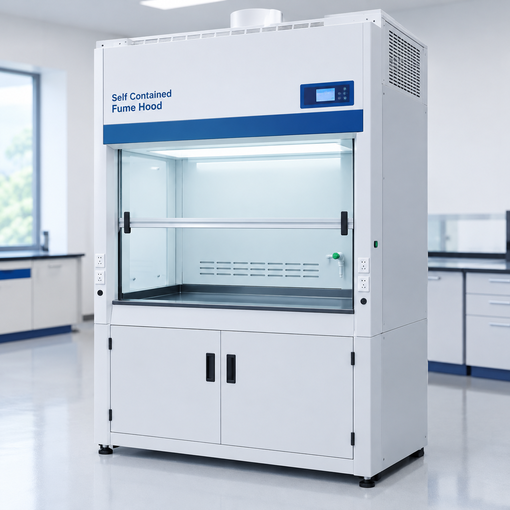
A Self-Contained Fume Hood—also called a ductless or recirculating fume hood—is a laboratory enclosure that captures chemical vapors, odors, and particulates at the work surface, filters them internally, and returns cleaned air to the room. It needs no external ductwork or building exhaust connection.
How Self Contained Fume Hood works
-
A built-in blower draws air through the front opening, creating a containment zone over the work area.
-
Air passes through a pre-filter and then a chemical filter—typically activated carbon for vapors, or HEPA for particulates.
-
Filtered air is recirculated into the laboratory rather than exhausted outside.
Typical face velocity is around 0.4–0.6 m/s, though the correct specification depends on the application and local safety assessment.
Best uses of Self Contained Fume Hood
-
Light-duty handling of solvents, acids, formaldehyde, ammonia, odors, and similar chemical vapors in small quantities.
-
Teaching labs, quality-control benches, mobile or temporary workstations, and labs where ducting is impractical.
-
Applications needing both vapor and particulate control, when fitted with the appropriate carbon and HEPA filtration.
- Typical face velocity is around 0.4–0.6 m/s, though the correct specification depends on the application and local safety assessment.