
Fume Cabinet
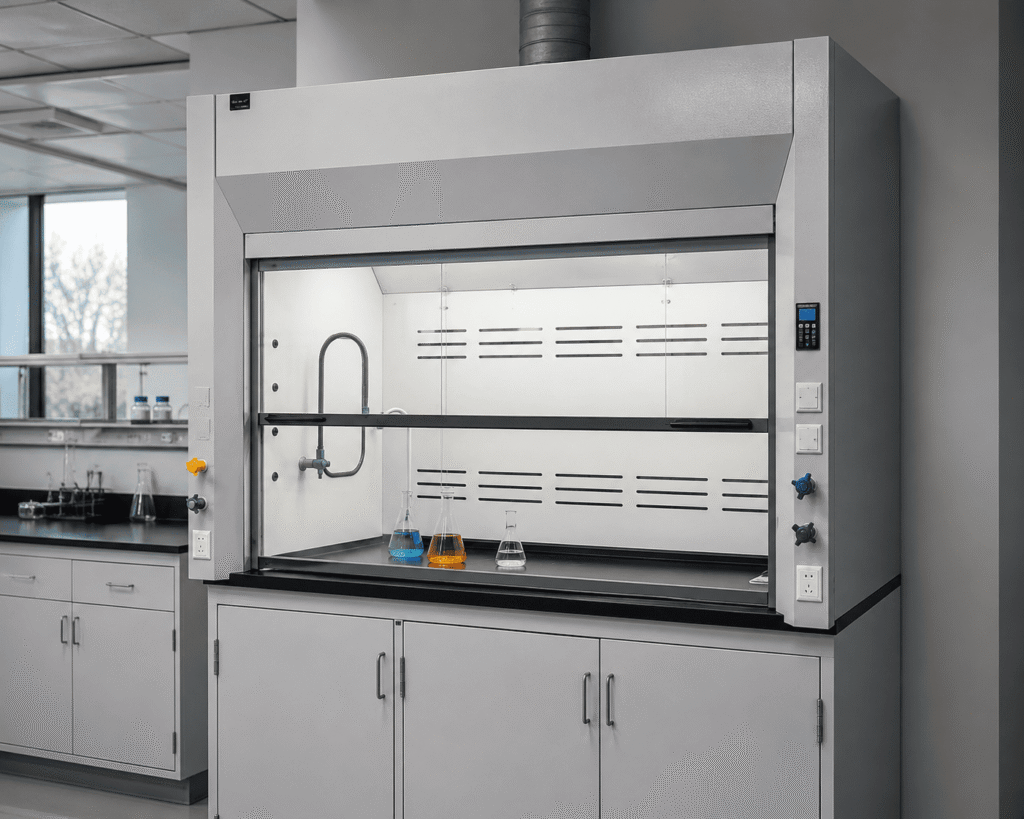
A fume cabinet (also called a fume cupboard or fume hood) is a ventilated, partially enclosed workstation used in laboratories and industrial settings to capture and remove hazardous chemical fumes, vapours, mists, and dust before they can be inhaled by the operator or spread into the room.
What it is and how it works
- It’s essentially a box-like enclosure with a transparent front sash (sliding glass panel) that the user works through.
- A mechanically induced inward airflow is created through the front opening (the “working aperture”), pulling contaminated air away from the user and into the cabinet.
-
The contaminated air is then either:
-
Ducted outside via an exhaust fan and ductwork, where it is diluted and discharged above roof level, or
-
Recirculated after passing through filters (carbon/HEPA or other media) that remove contaminants, returning cleaned air to the lab.
-
This controlled airflow both contains contaminants inside the cabinet and dilutes them, minimizing transient leakage from the opening.
Main components
Typical fume cabinets include:
-
Sash (glass window/panel): Adjustable front opening; provides a physical barrier and helps control face velocity.
-
Work chamber / interior: Chemical-resistant lining (often stainless steel, epoxy resin, or other corrosion-resistant materials).
-
Baffles / airflow guides: Internal panels that shape and stabilize airflow to improve containment.
-
Exhaust fan and ducting (for ducted types): Moves air out of the cabinet and building.
-
Filtration system (for ductless/recirculating types): Activated carbon, HEPA, or specialized filters to trap chemicals/particulates before recirculation.
-
Control panel / monitors: On/off, fan speed, airflow indicators, alarms for low airflow or filter saturation.
-
Service fittings: Gas taps, water, electrical sockets, sinks, and sometimes acid storage cabinets below.
Types of fume cabinets
1. Ducted fume cabinets
- Air is drawn from the lab, through the cabinet, and exhausted to the outside atmosphere via ducts.
- Best for high volumes of hazardous or unknown chemicals, strong odours, and highly toxic or reactive substances.
- Requires proper building infrastructure: roof penetrations, duct runs, fans, and make-up air systems.
2.Recirculating (ductless) fume cabinets
- Air is pulled through filters inside the unit and returned to the room.
- Useful where ducting is impractical or too costly, or for specific, well-characterized chemicals compatible with the filters.
- Requires regular filter monitoring and replacement; not suitable for all chemical types (e.g., some highly toxic or unknown mixtures).
3. Variable Air Volume (VAV) vs Constant Air Volume (CAV)
- CAV: Fan runs at fixed speed; face velocity changes as sash height changes. Simpler but less energy-efficient.
- VAV: Adjusts airflow to maintain a target face velocity as the sash moves, saving energy while keeping protection consistent.
Primary uses
Fume cabinets are used to safely handle:
- Corrosive chemicals (acids, bases)
- Toxic gases and vapours (solvents, reagents)
- Flammable liquids and vapours
- Odorous or irritating substances
- Reactive materials that may release hazardous by-products
They are common in:
- Chemical, pharmaceutical, and biotech labs
- Quality control and R&D labs
- Educational institutions (schools, colleges, universities)
- Industrial labs and pilot plants
Performance and safety parameters
Key performance aspects include:
- Face velocity: Typical recommended range is about 0.3–0.5 m/s (60–100 fpm) at the sash opening.
- Containment efficiency: Ability to prevent escape of contaminants when the sash is at normal working height
- Airflow monitoring and alarms: To warn of low airflow, blocked filters, or fan failure.
- Proper installation and commissioning: Including airflow balancing, smoke tests, and periodic testing to ensure safe operation.
Good practice also includes:
- Keeping the sash as low as practical during work.
- Not using the cabinet as general storage (which disrupts airflow).
- Avoiding rapid movements near the opening that can disturb airflow.
Fume cabinet vs biosafety cabinet (important distinction)
- Fume cabinet / fume hood:
-
Fume cabinet / fume hood:
-
Protects personnel from chemical fumes and vapours.
-
Air is exhausted outside or filtered for chemicals; not designed for sterile work or biological containment. labconco+2
-
-
Biosafety cabinet (BSC):
-
Protects personnel, product, and environment from biological agents (microbes, cell cultures).
-
Uses HEPA filtration and laminar airflow; not intended for most volatile chemicals.
-
Choosing the wrong type can compromise safety, so match the cabinet to the hazard (chemical vs biological).