
Portable Lab Hood
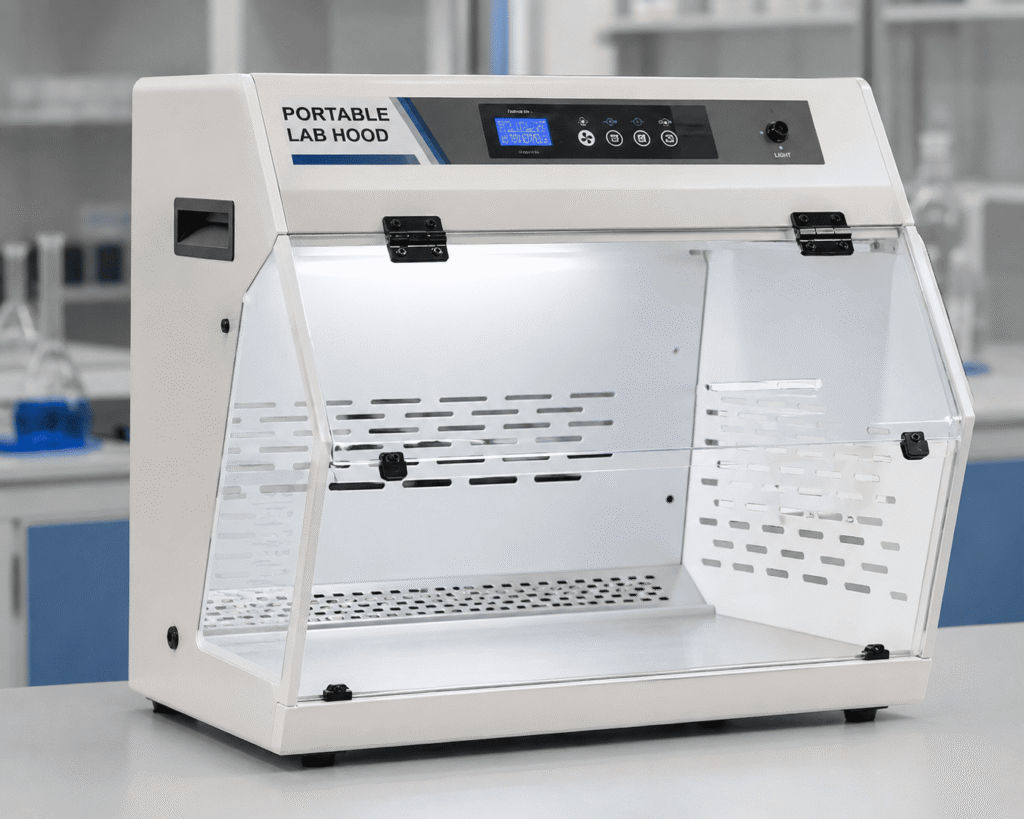
Portable lab hoods (also called portable/mobile fume hoods, ductless fume hoods, or portable ventilated enclosures) are self-contained or relocatable containment devices that protect laboratory personnel from hazardous fumes, vapors, gases, and particulates. Unlike fixed ducted fume hoods permanently tied to building exhaust systems, portable versions emphasize mobility, quick setup, and flexibility.
They are widely used in teaching labs, temporary or leased spaces, research with known/low-volume chemicals, demos, weighing of powders, soldering, and modular or reconfigurable laboratories.
Main Types
- Ductless (Recirculating) Portable Fume Hoods — Most common true portable option.
Contaminated air is drawn in, filtered (typically through pre-filters + activated carbon for chemical vapors + optional HEPA/ULPA for particles), and returned clean to the room. No external ductwork is required. Units often sit on benches or mobile stands with casters. - Flexibly Ducted Portable Hoods — Connect via flexible hose (e.g., 2–6 inch diameter) to a building exhaust or external fan. They offer broader chemical compatibility than pure ductless models but need access to exhaust infrastructure. Examples include units with locking casters and flexible duct kits.
- Portable Cleanroom / Laminar Flow / Positive-Pressure Hoods — Designed primarily for process protection rather than operator protection from chemicals. They supply HEPA/ULPA-filtered air in a laminar (usually vertical) flow to create an ISO Class 5 (or better) clean environment. Common for IV prep, tissue culture, optics assembly, and sensitive assembly work. Often lightweight with vinyl curtains.
- Specialized Portable Enclosures —
- Ventilated balance enclosures (for weighing fine powders; low turbulence, HEPA options).
- Local capture hoods (lightweight, aerodynamic designs for soldering, rodent surgery, or point-source capture; can be very light, ~5 lbs).
- Demonstration/tabletop hoods for education
Key Features and Components
- Enclosure — Transparent panels (polycarbonate, acrylic, or glass) with a front sash (sliding or hinged) for access and visibility. Work surfaces are often chemical-resistant (epoxy resin, phenolic, polypropylene, or stainless).
- Airflow system — Blower/fan maintaining face velocity (typically targeting 60–100 fpm depending on design and standards). Variable-speed controls are common.
- Filtration (ductless models) — Multi-stage: pre-filter (dust), main carbon (organics, acids, ammonia, etc.—specialized carbons available), and HEPA (99.97% at 0.3 µm) or ULPA. Some include real-time VOC sensors, saturation alarms, and airflow monitors.
- Mobility — Locking swivel casters, compact benchtop sizes (e.g., 24–48 inches wide), or full mobile carts. Lightweight designs for easy relocation.
- Other — LED lighting, duplex outlets, service fixtures (on some models), spill trays, noise levels typically in the 50–70 dB range, and plug-and-play 110/220 V power.
- Sizes — From mini benchtop (~12–24 inches) to larger mobile units (48–96+ inches). Interior work areas vary; typical depths are 18–30 inches.
How They Work
Air is pulled from the lab into the open face (negative pressure relative to the room). Contaminants are captured at the source. In ductless units, air passes through filters and is recirculated; in ducted portable units, it is exhausted externally via flexible duct. Face velocity and containment performance are critical—poor design or improper use reduces protection.
Advantages
- High flexibility: Easy to move, reconfigure labs, or use in temporary/rented spaces without roof penetrations or major construction.
- Lower upfront and installation costs (especially ductless: often plug-and-play; no ductwork, exhaust fans, or major HVAC changes).
- Energy efficiency: Ductless models do not exhaust large volumes of conditioned air (a major ongoing cost of traditional hoods).
- Faster deployment and modularity for evolving research needs or educational settings.
- Reduced environmental impact (no direct discharge of filtered contaminants outdoors in recirculating designs).
Applications
Teaching and demonstration labs, histology/pathology, powder weighing and handling, light chemical work with known solvents/acids, electronics/soldering, temporary research setups, clean processes (tissue culture, assembly), mobile or outreach labs, and facilities where ductwork is impractical (historic buildings, upper floors, leased space).
| Aspect | Ductless Portable | Flexibly Ducted Portable |
| Installation | Minimal / plug-and-play | Needs exhaust access + flexible duct |
| Chemical range | Limited to filter-compatible | Broader |
| Energy use | Low | Higher (exhausts room air) |
| Mobility | Excellent | Good (limited by duct length) |
| Ongoing costs | Filters | Energy + occasional duct checks |
| Best for | Known/low-volume, flexible spaces | When exhaust is available |