
Intelligent Air Shower
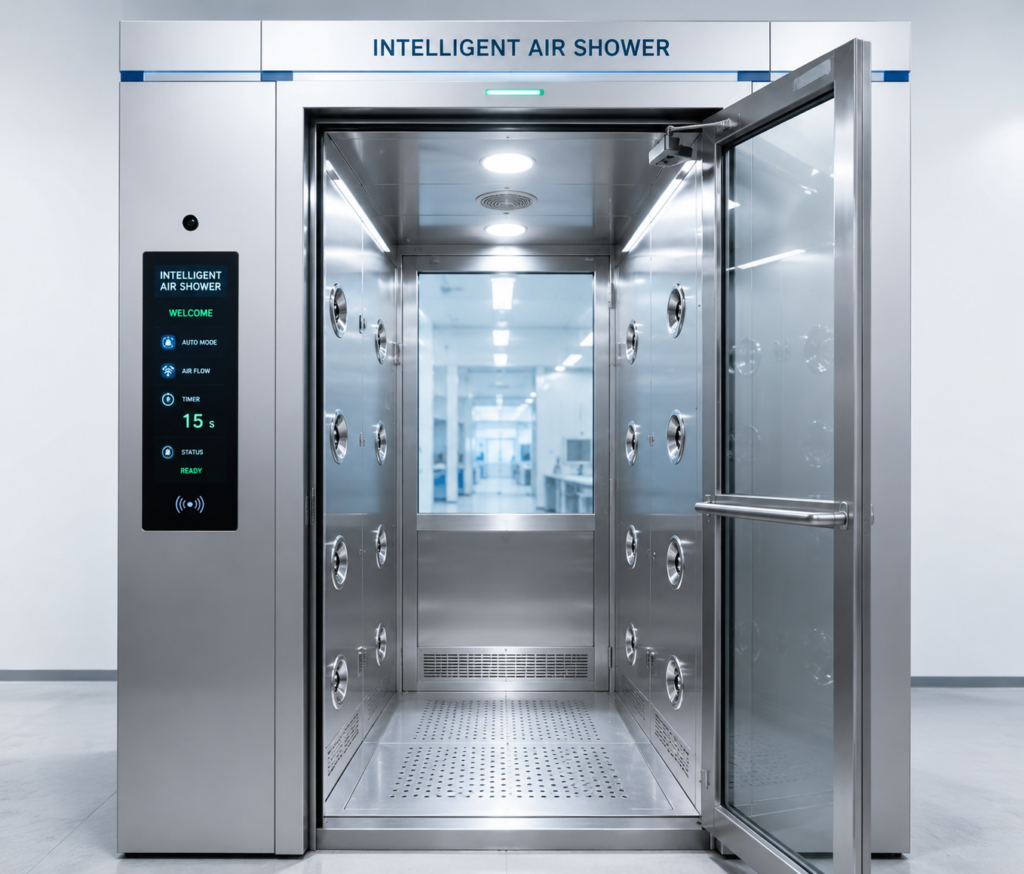
Intelligent air showers are advanced versions of cleanroom air shower chambers. These enclosed units remove particulate contamination from personnel, clothing, or materials using high-velocity filtered air before entry into controlled environments (e.g., cleanrooms). “Intelligent” refers to automation, sensors, programmable controls, interlocking safety systems, voice guidance, and in some cases biometrics, particle monitoring, sterilization, or adaptive/AI features.
Intelligent Air Shower Working Principle
Air showers act as a contamination-control buffer between non-clean and clean zones. They prevent external particles from entering ISO-class cleanrooms used in pharmaceuticals, semiconductors, electronics, biotechnology, food processing, and medical device manufacturing.
Basic operation:
- Personnel or materials enter via an outer door.
- Sensors detect presence and automatically start the cycle (doors interlock so only one can open at a time, preventing cross-contamination).
- High-velocity clean air (typically 20–30 m/s or higher) is blown from multiple adjustable nozzles on walls and ceiling.
- Air passes through pre-filters then HEPA (or ULPA) filters that capture ≥99.97% of particles ≥0.3 µm (higher efficiencies available).
- Dislodged particles are recirculated and re-filtered within the chamber.
- After a timed cycle (often 10–60 seconds, programmable; commonly 15–40 s), the system stops and unlocks the inner door to the clean area.
- Voice prompts guide users (“Please close the door,” cycle status, etc.)
Intelligent models add automation so the process requires minimal or no manual intervention.
Key Intelligent Features
Modern systems incorporate:
- Automatic sensing and start/stop — Infrared, ultrasonic, or motion sensors detect personnel/objects and initiate/cease the cycle for efficiency and energy savings.
- Programmable controls — PLC, touchscreen HMI, or microcontroller for setting shower time, air velocity, cycles, and parameters. Some support multi-level authority management.
- Interlocking electronic doors — Prevent simultaneous opening of inner and outer doors; often with door closers and emergency overrides.
- Voice announcement systems — Guide users through steps and status.
- High-efficiency multi-stage filtration — Pre-filter + HEPA/ULPA (H13/H14 or better); self-circulating airflow.
- Adjustable/omnidirectional nozzles — Multiple nozzles (12–40+ depending on size) for full-body coverage; some rotate or allow angle adjustment to reduce dead zones. Air speeds often ≥25 m/s.
- Advanced sensing and adaptive control (in higher-end/intelligent models):
- Particle counters for real-time cleanliness monitoring and dynamic evaluation.
- Dust concentration or airflow sensors that adjust fan power/air volume for energy efficiency and better performance.
- Biometric access (facial or eye recognition) for authorized personnel and contactless entry.
- UV sterilization or alcohol mist spraying in some designs for microbial control alongside particle removal.
- IoT/AI/smart features (emerging models) — Connectivity for monitoring, data logging (useful for GMP compliance), remote management, fault diagnosis, and adaptive parameters based on load or conditions. Some consumer/building-oriented “smart air showers” use sensors for indoor/outdoor air quality and fine-dust removal.
- Safety and usability — Emergency stop, low-noise design (<65–75 dB), LED lighting, stainless steel (304/316 or equivalent) construction for durability and cleanability, optional ionizing nozzles for static-sensitive environments (e.g., semiconductors).
Typical Technical Specifications
Specifications vary by model (single-person, multi-person, tunnel, or material pass-through) and can be customized:
- Dimensions — Example single/two-person: external ~1300–1500 × 1000–1500 × 2100–2200 mm; internal clearance for standing users.
- Capacity — 1–4+ persons or continuous tunnel designs for high traffic.
- Nozzles — 12–18+ common; more in larger units.
- Fans/motors — High-velocity blowers (often 0.55–1.1+ kW each); EC motors in some for efficiency.
- Air velocity — ≥20–25 m/s (up to 30+ m/s).
- Filtration — HEPA H13/H14 or ULPA; dual systems common.
- Cycle time — Adjustable, e.g., 10–99 s.
- Materials — Stainless steel (201/304 preferred), powder-coated options; glass-view doors.
- Power — Typically 220/380 V, multi-phase.
- Noise — Often <65 dB.
Door-less or kit-style ion air showers exist for certain applications, emphasizing high removal rates (claimed >90% in specialized designs) and mobility.
Benefits
- Significantly reduces particle load entering cleanrooms, protecting processes and product quality.
- Extends life of main cleanroom filters and HVAC systems.
- Ensures protocol compliance and supports regulatory standards (ISO 14644, GMP, etc.).
- Energy savings and higher efficiency via sensors and adaptive control versus always-on or purely manual systems.
- Improved user experience and reduced human error through automation and guidance.
- Data logging and monitoring support quality management and continuous improvement.
Applications
Primarily industrial/scientific: pharmaceutical manufacturing, semiconductor fabs, electronics assembly, biotech labs, medical devices, food processing, aerospace, and research facilities requiring strict contamination control. Some smart/consumer variants target building entrances or personal fine-dust/allergen reduction.
Intelligent air showers represent an evolution from basic high-velocity air chambers to sensor-driven, automated, and increasingly connected systems that improve reliability, efficiency, and integration into modern cleanroom operations. Specific performance depends on the manufacturer, model, installation, and maintenance (filter changes, nozzle checks, etc.). For procurement or detailed engineering data, consult manufacturers specializing in cleanroom equipment, as units are often customized.