
Types of Biological Safety Cabinets
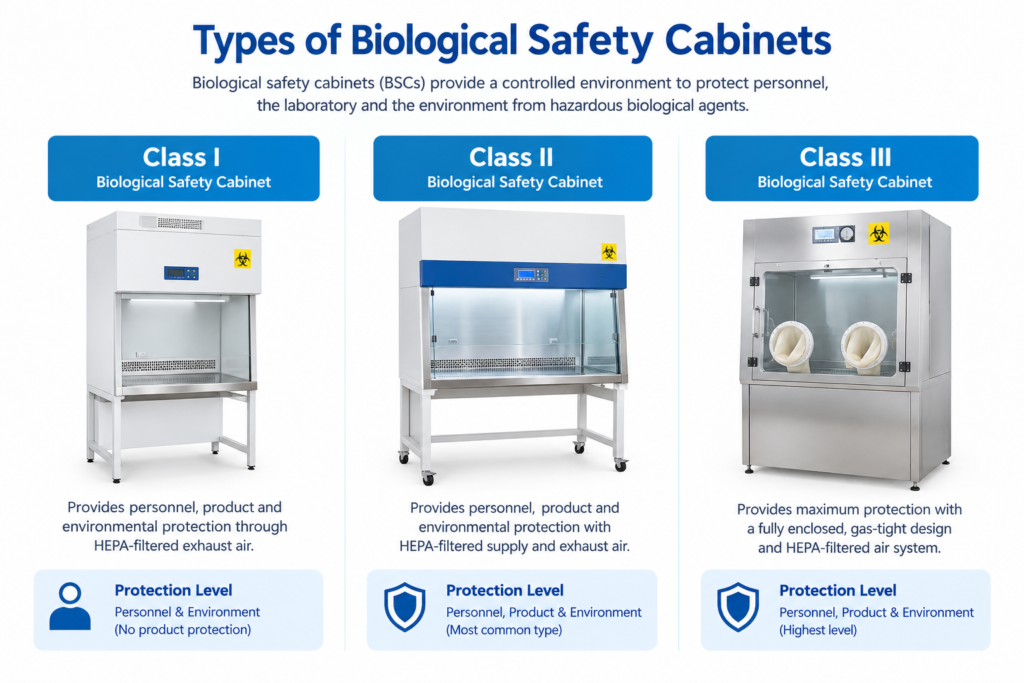
Biological Safety Cabinets (BSCs) are ventilated containment devices used to protect laboratory personnel, the environment, and sometimes the material being handled. They are divided into three classes—I, II, and III—with Class II further divided into Types A1, A2, B1, and B2.
Types of Biological Safety Cabinets
| Class | Protection provided | Airflow / design | Typical use |
|---|---|---|---|
| Class I | Personnel and environment; no product protection | Room air is drawn inward across the work opening and exhausted through a HEPA filter | Low- to moderate-risk agents; operations that generate aerosols but do not need a sterile product |
| Class II | Personnel, environment, and product | HEPA-filtered vertical laminar downflow plus inward airflow at the front opening | Most common in research and clinical labs; suitable for many BSL-2 and BSL-3 workflows |
| Class III | Maximum personnel, environmental, and product protection | Fully enclosed, gas-tight glove-box design; supply and exhaust air are HEPA-filtered | Highly infectious agents, especially BSL-4 work |
Class II types
Class II cabinets are the most frequently used BSCs and are subdivided by recirculation, exhaust arrangement, and suitability for volatile chemicals.
| Type | Key features | Chemical/volatile use |
|---|---|---|
| Type A1 | About 70% of air recirculates through the supply HEPA filter; typically not hard-ducted | Not for volatile toxic chemicals or radionuclides |
| Type A2 | Similar recirculating design but with higher inflow velocity; may be canopy- or thimble-connected | Limited work with small amounts of low-risk chemicals |
| Type B1 | About 30% recirculated; exhaust is HEPA-filtered and hard-ducted | Small quantities of volatile chemicals or radionuclides |
| Type B2 | Total-exhaust design: no recirculation; all air is exhausted through HEPA filtration and hard ducting | Best choice when using significant quantities of volatile toxic chemicals or radionuclides |