
Pass Box Clean Room
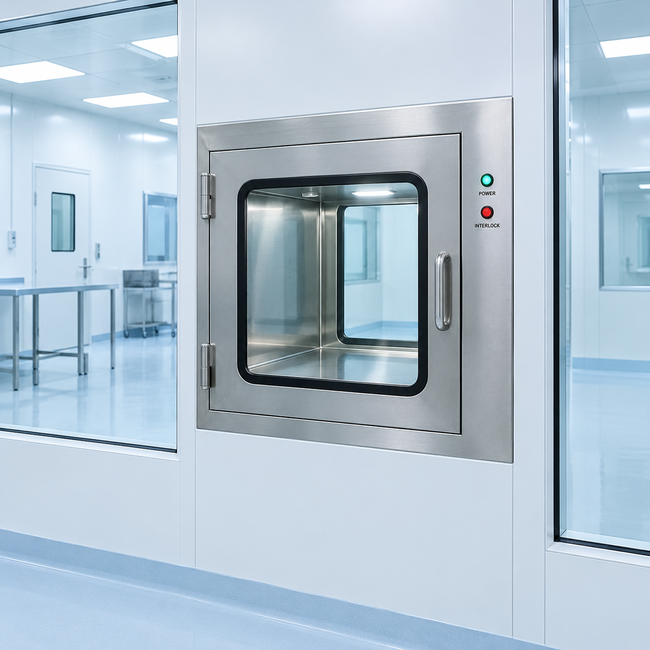
A Pass Box Clean Room (also called a pass-through or transfer hatch) is a small double-door chamber built into a cleanroom wall. It lets materials move between areas of different cleanliness without people opening the main cleanroom door, reducing contamination, airflow disruption, and unnecessary personnel traffic.
How Pass Box Clean Room works
-
An item is placed inside through the “dirty” or lower-classification side.
-
The outer door closes and locks.
-
The item may be wiped down, UV-treated, or exposed to filtered air, depending on the unit.
-
The interlock releases the clean-side door, allowing retrieval from the cleanroom.
The key feature is the door interlock: both doors cannot be open at the same time, preventing direct air exchange and cross-contamination between zones.
Main types
| Type | Features | Typical use |
|---|---|---|
| Static / passive pass box | No forced ventilation; interlocked doors; may include UV lamp | Transfer between two clean areas or for non-sensitive materials |
| Dynamic / active pass box | HEPA-filtered air, blower, sometimes higher internal pressure | Transfer between classified and unclassified areas, or where surface particle removal is needed |
| UV pass box | Ultraviolet lamp for surface disinfection | Materials where UV-compatible disinfection is appropriate |
Common construction
Pass boxes are commonly made from smooth, cleanable 304 or 316L stainless steel, with flush doors, viewing panels, rounded internal corners, and minimal ledges to support cleaning and disinfection.
Why cleanrooms use them
-
Reduces the number of times the cleanroom door is opened.
-
Limits particle ingress and cross-contamination.
-
Helps preserve pressure differentials and cleanliness classification.
-
Speeds up transfer of samples, tools, packaging, and small equipment.