
October 6, 2026
·
admin
INDUSTRIAL AIRSHOWER
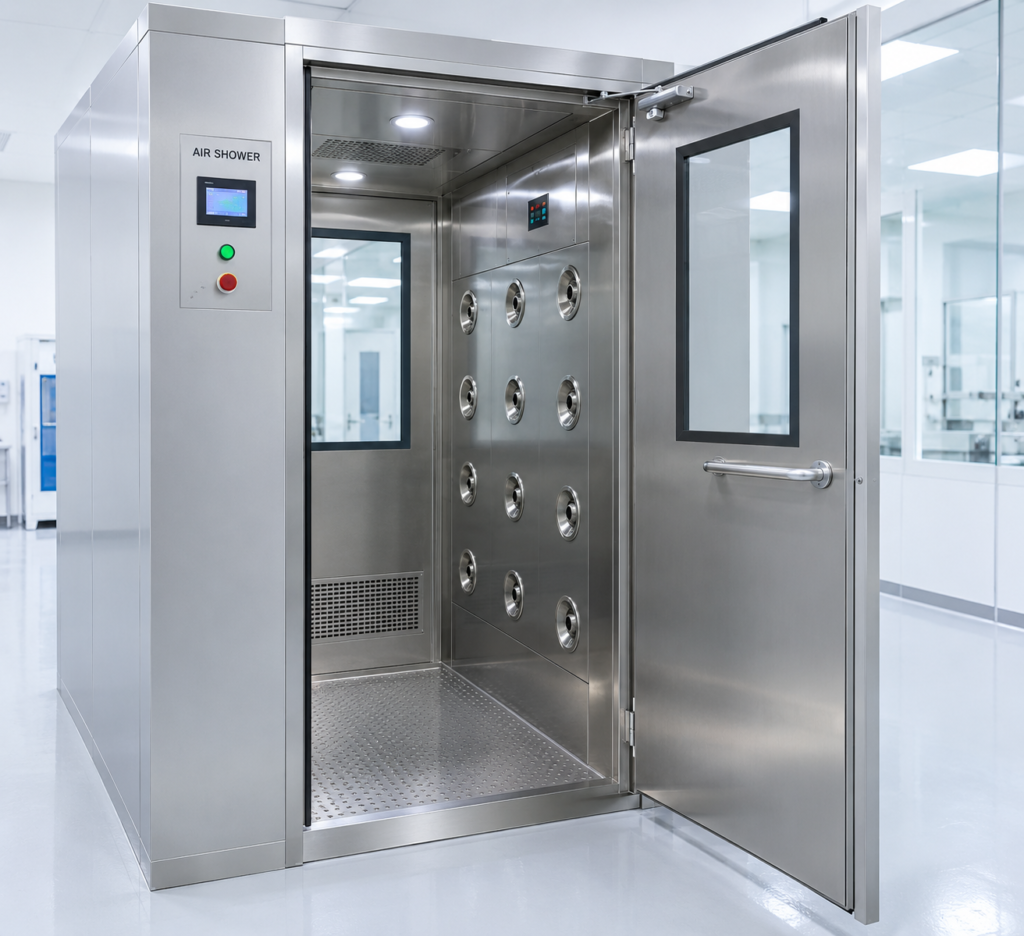
Industrial Air Shower
An industrial air shower is a self-contained cleanroom entry system that removes dust and particulate contamination from personnel, garments, equipment, or carts before they enter a controlled environment. It uses high-velocity, HEPA-filtered air jets and typically includes interlocked doors, blowers, filters, nozzles, and an automatic control panel.
Main applications
- Pharmaceutical and API manufacturing.
- Medical-device and surgical-instrument production.
- Laboratories and biotechnology facilities.
- Electronics, semiconductor, and precision engineering plants.
- Food, dairy, cosmetics, and packaging industries.
- Sterile operating areas and controlled healthcare facilities.
- Cleanroom material and trolley transfer.
How it works
- The operator enters the air-shower chamber.
- Entry and exit doors remain interlocked during the cycle.
- High-speed air jets blow contaminants from clothing, PPE, equipment, or carts.
- Contaminated air passes through return grilles and filtration.
- After the preset cycle—commonly adjustable from 0–99 seconds—the exit door unlocks.
Typical systems use air velocities around 20–25 m/s and H14 HEPA filtration with an efficiency of approximately 99.997% for 0.3-micron particles, although exact specifications vary by design.
Common types
Type |
Suitable for |
| Personnel air shower | One or more workers entering a cleanroom |
| Cargo air shower | Materials, boxes, and small equipment |
| Trolley air shower | Carts and mobile production equipment |
| Tunnel air shower | High-volume movement of people or materials |
| Pass-through air shower | Controlled transfer between rooms |
| Single-door or double-door | Different layout and access requirements |
| Top-and-side blow type | Better coverage where ceiling height or airflow layout is important |
Typical specifications
For a pharmaceutical or laboratory project, a practical specification may include:
- Construction: SS 304; SS 316L for corrosive or highly hygienic applications.
- Internal finish: Smooth, coved, easy-to-clean surfaces.
- Filtration: Pre-filter or EU7/MERV stage plus H13/H14 HEPA filter.
- Air velocity: Approximately 20–25 m/s at the nozzle.
- Nozzles: Adjustable stainless-steel nozzles on both sides, with optional ceiling nozzles.
- Control: PLC or microprocessor-based control panel.
- Door system: Electromagnetic or automatic interlocking doors.
- Cycle timer: Adjustable, often 0–99 seconds.
- Lighting: Flush-mounted LED light.
- Safety: Emergency release, overload protection, door-status indication.
- Power: Usually 230 V single-phase for smaller units or 380/415 V three-phase for larger systems.
- Optional features: UV-C, voice instruction, access control, VFD blower control, differential-pressure monitoring, and explosion-proof construction.
Important selection points
When sourcing or manufacturing an industrial air shower, do not evaluate it only by the number of nozzles. Check:
-
Actual nozzle velocity and airflow volume.
- HEPA filter grade, dimensions, and test certificate.
- Filter replacement accessibility.
- Door interlock reliability and emergency release.
- Noise level and blower power consumption.
- Internal chamber dimensions and user capacity.
- Compatibility with the cleanroom pressure cascade.
- Material grade and weld quality.
- Availability of spare filters, motors, sensors, and control components.
- FAT/SAT documentation, airflow testing, and HEPA integrity testing.
CONCLUSION:
An air shower improves contamination control but does not sterilize a person or material. It should be used together with proper gowning, cleaning procedures, pressure differentials, and cleanroom qualification.